

It Feels Like Perimenopause. Often It Is Not.
You are somewhere in your forties. The word you wanted is gone by the time you reach for it. By 3pm you hit a wall you have to push through, and by the time everyone gets home and needs you most, your patience is already spent. Your period comes early, then late, then heavier than it used to be. You finally said something out loud, and the answer came back fast: it is probably perimenopause. Wait it out. Maybe try the patch.
Here is what we want you to hear first. You are not imagining it, and you are not being dramatic. Something real is happening in your body.
And the perimenopause part may even be true. But "it is probably perimenopause, wait it out" is where the investigation usually stops, right when it should be starting. Because the exact cluster you just described, the fog, the crashes, the mood that turns on a dime, the sleep that is suddenly fragile, overlaps almost perfectly with your thyroid, your blood sugar, and your gut. Perimenopause is often part of the picture. It is rarely the whole picture.

Perimenopause Is Real. It Is Also Not the Whole Story.
Perimenopause is not a switch that flips. It is a staged transition that can run four to eight years before your final period, and the hormonal changes across it are anything but smooth.
You very likely already know the sex hormones are shifting. Estrogen, progesterone, and testosterone all move through this transition, and not in a tidy downward line. Estradiol in particular can spike higher than it did in your thirties before it eventually falls. That is exactly why a single blood draw on one day tells you so little about estrogen and progesterone. You could be tested on a high day and a low day in the same month and walk away with two different answers. For those, we use cycle-based, at-home urine testing that maps the major sex hormones, estrogen, progesterone, FSH, and LH, across your whole cycle. Testosterone and its precursors are a different case: we measure those by serum, using the more accurate mass spectrometry (MS) method instead of a standard blood test.
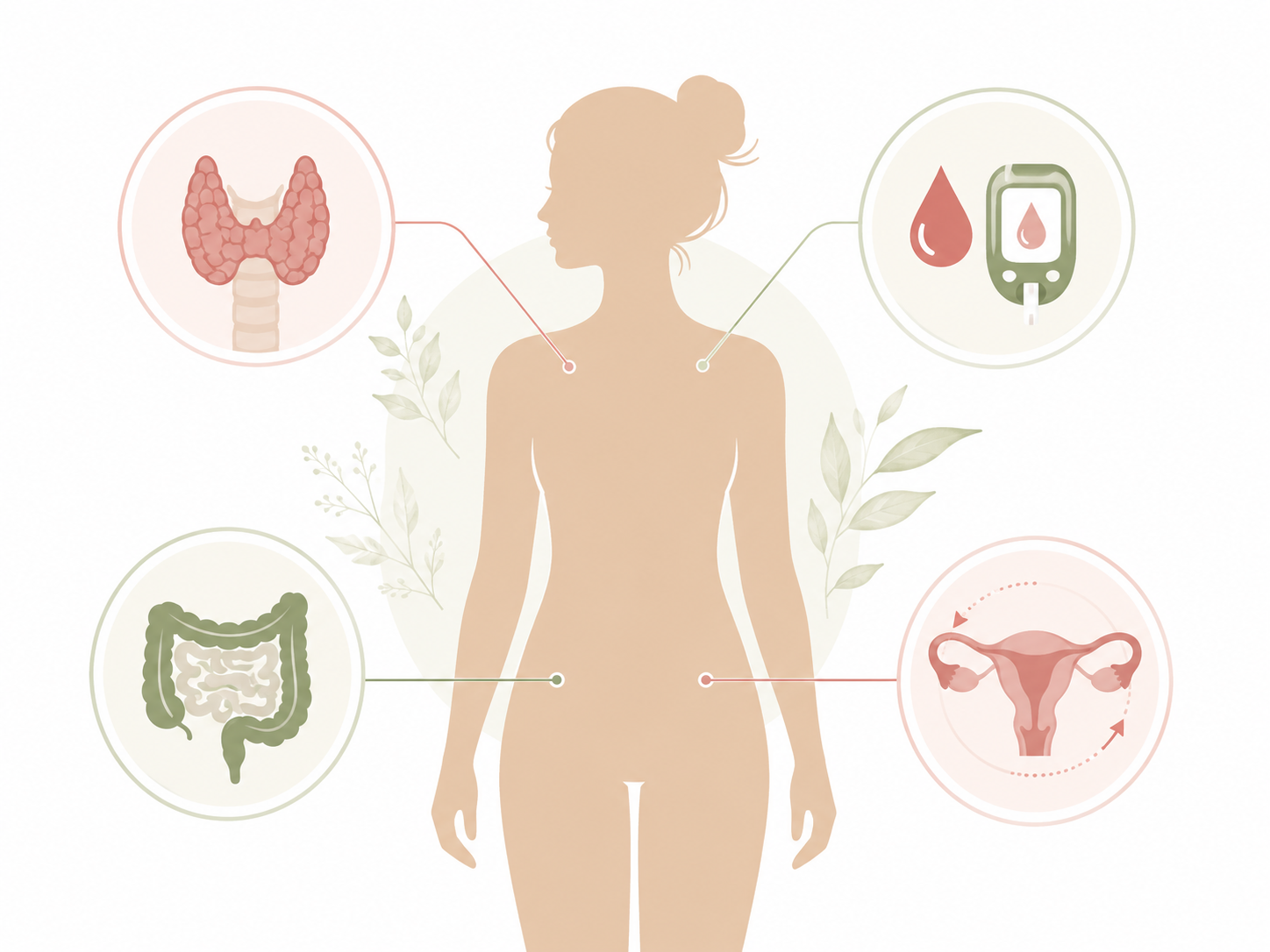
The Systems That Get Blamed on Perimenopause
When we connect the dots for a woman in her forties, the same handful of drivers show up again and again underneath the perimenopause label. These are the ones worth ruling in or out before you accept "wait it out."
Your Thyroid
Thyroid disease is common in midlife women, and its symptoms are nearly identical to the menopause transition: fatigue, brain fog, weight that will not move, low mood, cold hands, thinning hair. It is also underdiagnosed, precisely because those symptoms get waved off as menopause.
A single "normal" TSH does not rule it out. We look at free T3, free T4, reverse T3, and thyroid antibodies, because you can make enough thyroid hormone and still not convert it into the active form your cells can use. Selenium drives that T4-to-T3 conversion, which is one reason nutrient status matters as much as the hormone number.
Your Blood Sugar
Estrogen helps keep your body sensitive to insulin. As it fluctuates and falls, insulin sensitivity can drop with it, which means the same meals start landing differently. That is the 3pm crash, the afternoon edge, the wired-but-tired evenings. It looks like a mood shift. It often starts as a glucose swing. A fasting insulin and glucose, not just an A1c, is where we can catch it early.
Your Gut
Here is the link almost no one mentions. A specific community of gut bacteria, the estrobolome, helps regulate how much estrogen stays in circulation, through an enzyme called beta-glucuronidase. When the gut is inflamed or out of balance, estrogen handling shifts with it. So the bloating and the hormone symptoms you have been treating as two separate problems are frequently the same problem wearing two coats.
Your Brain
The fog has a mechanism. Processing speed and memory can genuinely dip during the late transition, and tend to recover afterward. Naming that is its own kind of relief. The dropped word and the lost thread are real, they have a cause, and for most women, a timeline.

Why Your “Normal” Labs Miss All of This
If you have already had bloodwork and been told everything looks fine, that is not the end of the conversation. Standard panels are built to catch disease, not the early, connected drift that makes you feel like a stranger in your own body. Normal is a population average. It is not the same as optimal, and it is not the same as normal for you.
Two things tend to go wrong. The panel is too narrow: a lone TSH instead of a full thyroid panel, an A1c instead of fasting insulin, no look at the gut at all. And the results get read in isolation, one marker at a time, instead of as one connected system. We went deeper on that in "When Your Labs Are 'Normal' But You Still Don't Feel Well" , and on what a hormone panel actually needs to include in "The Missing Layer in Hormone Testing.”
What Connecting the Dots Actually Looks Like
This is the difference between a label and an answer. Instead of one hormone on one day, we map the whole system: cycle-based urine testing for the major sex hormones across your cycle, plus serum (MS) testing for testosterone and its precursors; a complete thyroid panel with antibodies and reverse T3; fasting insulin and glucose alongside the standard markers; iron and ferritin (heavy or erratic bleeding in the transition quietly drains them); and a real look at the gut. Then we read them together, against your symptoms and your history, not against a sick population's average.
I know the other version of this from the inside. Years ago my OB told me my TSH was slightly up but still "normal," and offered me a prescription to smooth it over. A specialist later told me I was completely healthy. I left and cried in the car, because I knew I was not. It turned out I had thyroid antibodies no one had thought to look for. Being believed, and then tested properly, changed everything. That is the whole reason GreenMind exists.
One more honest note. For a lot of women over forty, this same cluster, the fog, the trouble starting tasks, the 11pm second wind, also overlaps with ADHD that went unrecognized for decades, and shifting hormones can bring it to the surface. Sometimes it is hormones. Sometimes it is attention. Often it is both. We hold both possibilities rather than guess, and we wrote about that overlap in "Did Your ADHD Get Worse in Your 40s?"
There Is a Better Way
You do not have to wait it out, and you do not have to accept that this is simply your age with nothing to be done. Perimenopause may be part of your story. Even when it is, that does not make endurance the only option. When we connect the dots across your thyroid, blood sugar, sex hormones, and gut, the pattern almost always starts to make sense, and once it makes sense, it becomes something we can actually work with.
If you are ready to find out what is really going on, book a free Perspective Strategy Call (https://calendar.app.google/BuJZSaGGxRk2xC4WA) and we will start connecting the dots together.
Sources
Baker, J. M., Al-Nakkash, L., & Herbst-Kralovetz, M. M. (2017). Estrogen-gut microbiome axis: Physiological and clinical implications. Maturitas, 103, 45–53. HTTPS://DOI.ORG/10.1016/J.MATURITAS.2017.06.025
Greendale, G. A., Huang, M. H., Wight, R. G., Seeman, T., Luetters, C., Avis, N. E., Johnston, J., & Karlamangla, A. S. (2009). Effects of the menopause transition and hormone use on cognitive performance in midlife women. Neurology, 72(21), 1850–1857. HTTPS://DOI.ORG/10.1212/WNL.0B013E3181A71193
Harlow, S. D., Gass, M., Hall, J. E., Lobo, R., Maki, P., Rebar, R. W., Sherman, S., Sluss, P. M., & de Villiers, T. J. (2012). Executive summary of the Stages of Reproductive Aging Workshop + 10: Addressing the unfinished agenda of staging reproductive aging. The Journal of Clinical Endocrinology & Metabolism, 97(4), 1159–1168. HTTPS://DOI.ORG/10.1210/JC.2011-3362
Mauvais-Jarvis, F., Clegg, D. J., & Hevener, A. L. (2013). The role of estrogens in control of energy balance and glucose homeostasis. Endocrine Reviews, 34(3), 309–338. HTTPS://DOI.ORG/10.1210/ER.2012-1055
Mintziori, G., Veneti, S., Poppe, K., Goulis, D. G., Armeni, E., Erel, C. T., Fistonić, I., Hillard, T., Hirschberg, A. L., Meczekalski, B., Mendoza, N., Mueck, A. O., Simoncini, T., Stute, P., van Dijken, D., Rees, M., Duntas, L., & Lambrinoudaki, I. (2024). EMAS position statement: Thyroid disease and menopause. Maturitas, 185, 107991. HTTPS://DOI.ORG/10.1016/J.MATURITAS.2024.107991
Santoro, N., & Randolph, J. F., Jr. (2011). Reproductive hormones and the menopause transition. Obstetrics and Gynecology Clinics of North America, 38(3), 455–466. HTTPS://DOI.ORG/10.1016/J.OGC.2011.05.004