

SIBO: Why Eating More Fiber Can Make Your Bloating Worse
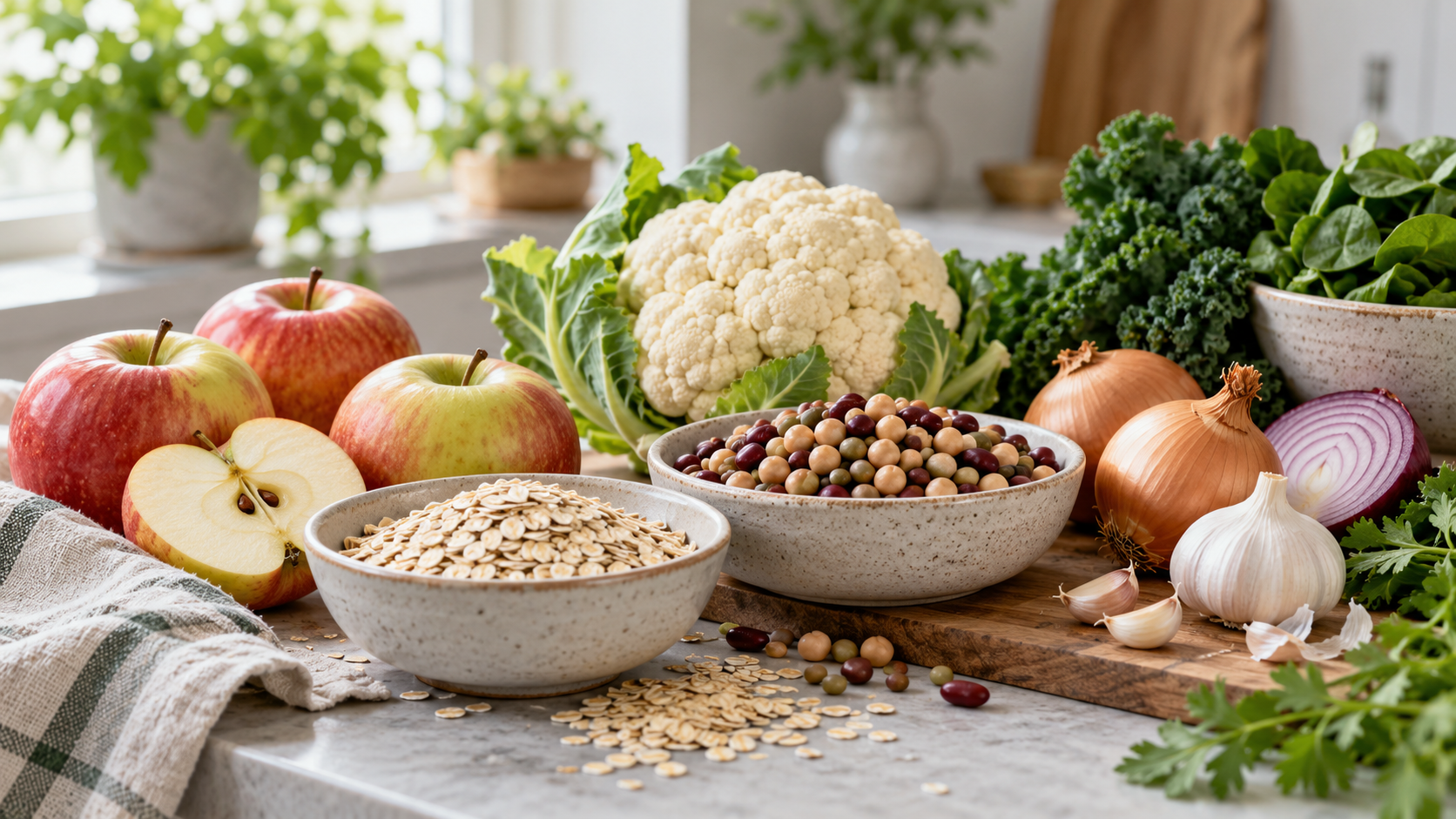
You have two different food lists now. One of them says fiber, water, movement, the advice you have followed for years and the only advice that has ever reliably made you go. The other one came with the SIBO diagnosis, and it says to cut the fiber. Cut the onions and the garlic. Cut the apples, the beans, the cauliflower.
You read the second list and reached a reasonable conclusion: the fiber is the only advice that has ever worked.
You are not confused. Both lists are right in different circumstances. They are aimed at two different sections of your gut, and nobody has told you which section is causing you issue.
The short answer: fiber does not cause bloating. Bacteria fermenting fiber cause bloating, and in SIBO those bacteria have moved into the small intestine, where food arrives first and undigested. The same fiber gets eaten upstream, early, and turns into gas before it reaches the colon it was meant to feed. So cutting fiber does quiet the symptom. It just does it by starving the colon bacteria that were never the problem.
Why both instructions felt right
Your large intestine is supposed to be full of bacteria. That is the design. Fiber arrives there mostly undigested. Resident bacteria ferment it, and what they produce does real work for your entire body. It feeds the cells lining your colon. These are important cells that make up part of your immune system. It also pulls water into the stool and keeps it moving regularly.
Your small intestine is supposed to be relatively quiet. Not sterile, but sparse.
In SIBO, that sparseness is gone. Bacteria that belong further down have set up where food lands first. According to PubMed, a 2023 review in the World Journal of Gastroenterology looked at patients with gut complaints who were given a breath test. It found SIBO in 33.8% of them, significantly associated with bloating and abdominal pain (Efremova et al., 2023).
So when you eat fiber, the fermentation that was supposed to happen slowly, downstream, over hours, happens immediately and in the wrong place. That is the bloating, and it is why it arrives so fast after eating that it feels like a reaction.
It is also why your instinct about the fiber was correct. Fiber is still pulling water into your stool exactly the way you noticed. You just have bacteria intercepting it first.
The problem is location, not the food
This matters more than it sounds, because it changes what you are treating.
If the food were the problem, the answer would be permanent avoidance, and your list would only ever get shorter. If the location is the problem, the answer is to fix the location, and the list is temporary.
Almost every woman we see with this history has been handed the first version. She arrives with a page of foods she has removed and a real fear of adding any of them back. Her diet feels one bad week away from being five foods. We wrote about this from the constipation side, and again when the fibermaxxing trend had everyone adding fiber indiscriminately. The pattern is the same in both directions. Fiber is being treated as good or bad on its own, when what determines the outcome is where it gets fermented.
Why the cleanup between your meals stopped running
Here is what usually hasn’t been explained.
Between meals, when your small intestine is empty, it runs a sweeping contraction from top to bottom. Clinicians call it the migrating motor complex. Its job is housekeeping: it pushes leftover food residue and bacteria downstream, toward the colon, where they belong. It only runs in the gaps. Eating interrupts it and resets it.
When that sweep weakens or runs too slowly, bacteria are not cleared efficiently, and they accumulate where they should not. That same review describes exactly this. SIBO often develops when transit slows, because the slowing reduces the normal clearance of bacteria from the small intestine (Efremova et al., 2023).
The bacteria are a consequence. The slowed sweep is the cause, and until you know why yours slowed down, you are treating the population and leaving the conditions intact.
One example from that review gets missed constantly. Proton pump inhibitor therapy (e.g., omeprazole) is a significant risk factor. Plenty of women have been on one for years, for reflux that was itself never fully explained.
If your thyroid is treated and your gut is still not right
Thyroid hormone is one of the inputs that sets the pace of that sweep. When it runs low, transit slows, and the clearance slows with it.
The association is measurable. According to PubMed, a study in the Journal of Clinical Endocrinology and Metabolism tested fifty patients with a history of overt hypothyroidism from autoimmune thyroiditis. It found 54% of them positive for bacterial overgrowth. Among the controls, 5%. Bloating, flatulence, and abdominal discomfort were significantly more common in the positive group, and those symptoms improved after the overgrowth was treated (Lauritano et al., 2007).
What cutting fiber costs you
Restriction does work. Pulling fermentable carbohydrates out reduces the fuel supply, and the gas goes down. If you are in the middle of it right now and finally comfortable, that relief is real and you should not feel bad about taking it.
In a randomized crossover trial published in Gut, participants ate two fully provided diets for 21 days each, identical except for fermentable carbohydrate content. The low-FODMAP period came with reduced total bacterial abundance and a higher stool pH. Compared with habitual eating, the higher-FODMAP diet supported a greater abundance of butyrate-producing bacteria (Halmos et al., 2015).
Butyrate is the compound your colon cells use as their primary fuel. It is made by bacteria fermenting the fiber you just removed. So the restriction that calms the upstream problem also reduces the supply of what maintains the lining downstream. The authors said plainly that the implications of long-term FODMAP reduction still require study.
How long should you stay on the restricted list?
Restriction was designed as a phase, not a destination. One group was followed for twelve months through structured restriction, then a formal reintroduction and personalization. Adequate symptom relief rose from 28% to 67%. Their beneficial gut bacteria ended no different from where they started. Butyrate was still lower (Staudacher et al., 2022). Although the study did have limitations with its small sample size, reintroduction recovered some of what restriction cost, and the people who reintroduced did better, not worse.
There is a sharper version of the same finding. In a randomized trial in Gastroenterology, one group took a prebiotic and one followed a low-FODMAP diet. Both improved. Then both stopped. Symptoms returned immediately in the low-FODMAP group, while relief persisted for two weeks in the prebiotic group (Huaman et al., 2018).
Taken together, these studies clarify what restriction is really doing. It suppresses the symptom, and it holds it down for as long as you hold the line, but it does not change the conditions underneath. That is why the list tends to grow over time, and why adding a food back can feel so risky. When nothing underneath has been repaired, the food will still cause symptoms. It is very easy to read that as proof you have developed yet another intolerance.
Where we start
When someone comes to us with this history, we are trying to answer one question: what slowed your digestive sweep down. The breath test has already told you that bacteria are in the wrong place. What it cannot tell you is why your small intestine stopped clearing them, and that is where we begin.
We look carefully at your thyroid, including the markers a standard panel tends to leave off. We look at whether you have spent years on a proton pump inhibitor, and at any abdominal surgery in your history. Both can change how well that sweep runs. We also spend real time on what was happening in your life and your health in the months before the symptoms started. That is often where the answer has been sitting all along. That root-cause work is what our SIBO care is built around.
Once we understand what slowed the sweep down, restriction can become what it was always meant to be. It is a temporary tool we use while we work on the underlying conditions, and we build the reintroduction plan from the beginning. You will always know how long it is meant to last and what comes next.
We also want to be honest with you about the limits of all this. A breath test can tell you that bacteria are there, and it cannot tell you why they are. That answer lives in your history and your labs, read together by someone who is looking at all of it at once. We also cannot always predict which women will relapse and which will not. What we can tell you is that you will not be handed another list of foods to avoid and left to manage it on your own.
If you have been eating from a shrinking list and you still do not know what started it, we would be glad to talk it through with you. It takes twenty minutes, there is no cost, and you will come away with a clear sense of what we would look at first and why.
Book a free 20-minute Prospective Strategy Call
Taryn White, MS, CNS, LDN, is a board-certified nutrition specialist and the founder of GreenMind Health in Richmond, Virginia.
Sources
Efremova, I., Maslennikov, R., Poluektova, E., et al. (2023). Epidemiology of small intestinal bacterial overgrowth. World Journal of Gastroenterology, 29(22), 3400-3421. https://doi.org/10.3748/wjg.v29.i22.3400
Halmos, E. P., Christophersen, C. T., Bird, A. R., Shepherd, S. J., Gibson, P. R., & Muir, J. G. (2015). Diets that differ in their FODMAP content alter the colonic luminal microenvironment. Gut, 64(1), 93-100. https://doi.org/10.1136/gutjnl-2014-307264
Huaman, J. W., Mego, M., Manichanh, C., et al. (2018). Effects of prebiotics vs a diet low in FODMAPs in patients with functional gut disorders. Gastroenterology, 155(4), 1004-1007. https://doi.org/10.1053/j.gastro.2018.06.045
Lauritano, E. C., Bilotta, A. L., Gabrielli, M., et al. (2007). Association between hypothyroidism and small intestinal bacterial overgrowth. The Journal of Clinical Endocrinology and Metabolism, 92(11), 4180-4184. https://doi.org/10.1210/jc.2007-0606
Staudacher, H. M., Rossi, M., Kaminski, T., et al. (2022). Long-term personalized low FODMAP diet improves symptoms and maintains luminal Bifidobacteria abundance in irritable bowel syndrome. Neurogastroenterology and Motility, 34(4), e14241. https://doi.org/10.1111/nmo.14241